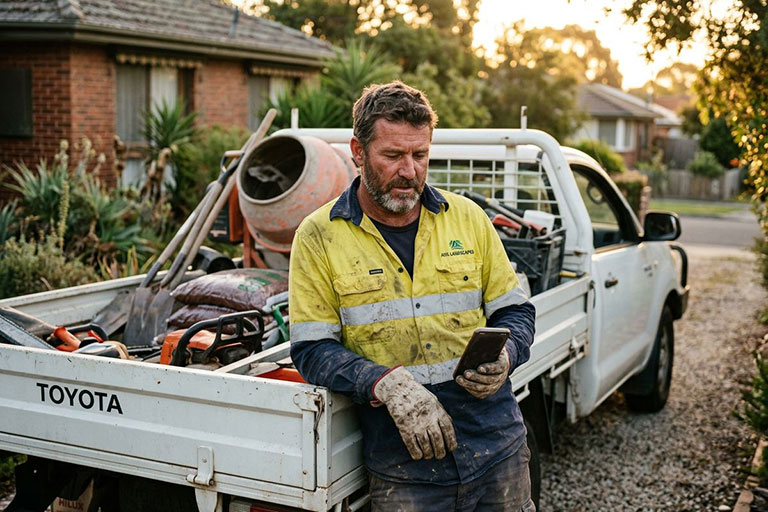
He went out on his own three years ago. Fully booked six weeks ahead. Charging more per day than he ever earned as an employee. And somehow, at the end of every month, the account barely moves.
This is one of the most common frustrations among self-employed tradespeople and landscapers in Australia – and the cause is almost always the same. The day rate looks good. The reality doesn’t, because the rate was never built from the right starting point.
Most trade contractors set their ABN rate by asking around – what does the bloke down the road charge, what will the builder pay, what feels like a step up from wages? Almost none of them start from the bottom: what do I actually need to earn to cover my costs, fund my own super, and take home a decent income?
That’s the calculation this article walks through. And the number it lands on is almost always higher than what most tradies are currently quoting.
What You Stop Getting the Day You Go ABN
Contents: Jump to a Section
When you’re on the tools as an employee – even a well-paid one – your take-home pay doesn’t tell the full story of what your employer is actually covering. The moment you go ABN, all of this disappears:
- Superannuation: 11.5% of your gross wage, paid by your employer on top of your salary. On a $75,000 wage, that’s $8,625 per year that simply stops when you go out on your own -unless you fund it yourself.
- Paid annual leave: four weeks per year. As a sole trader, those four weeks are four weeks of no income. At $650/day, that’s $13,000 in lost earnings you need to build into your rate.
- Sick leave: ten days per year as an employee. As a contractor, a sick day costs you the full day rate – plus any client disruption.
- Public holidays: approximately ten paid days per year on wages. As an ABN contractor, public holidays are unpaid unless you negotiate otherwise.
- Tools and equipment: some employers supply or subsidise equipment. ABN contractors fund their own – and that cost is ongoing.
- Work vehicle costs: ute payments, fuel, registration, insurance. If your employer previously provided a vehicle or a car allowance, that cost is now yours.
None of these appear on a quote. But every one of them has to come from somewhere – and that somewhere is your day rate.
The Real Costs of Running a Trade Business
Beyond losing employment benefits, trade contractors carry genuine business expenses that employed tradies don’t face:
- Public liability insurance: essential for any contractor working on residential or commercial sites. Typically $1,200–$2,500 per year depending on trade and coverage.
- Tool insurance: replacing stolen or damaged tools out of pocket is a real risk. Cover costs vary but $400–$800 per year is common.
- Vehicle running costs: fuel, servicing, registration, CTP. A working ute puts on serious kilometres – budget $8,000–$14,000 per year in operating costs depending on your territory.
- Accountant and bookkeeping: BAS lodgements, tax returns, and ABN compliance are not optional. Budget $1,500–$3,000 per year for a competent trade accountant.
- Equipment maintenance and replacement: blades, batteries, small tools, safety gear – the cost of keeping equipment operational adds up. Budget conservatively at $2,000–$4,000 per year.
- Licensing and registration fees: trade licences, white cards, industry body memberships, first aid renewals. These vary by trade but are a real annual cost.
- Quiet periods and weather days: landscapers and outdoor trades lose days to rain, extreme heat, and seasonal slowdowns. Budget for at least four to six weeks of reduced or no income per year.
- Marketing, website design and promotional costs.
| Estimated Annual Business Costs: Trade ContractorInsurance (liability + tools): $1,600 – $3,300 Vehicle operating costs: $8,000 – $14,000 Accountant: $1,500 – $3,000 Equipment maintenance: $2,000 – $4,000 Licensing, admin, and misc: $1,000 – $2,000 Conservative total: ~$14,000 – $26,000 per year This is before a single dollar of tax, super, or take-home pay. |
Working Backwards From What You Actually Need
Here is how the rate calculation works for a landscaper targeting $70,000 take-home per year – a solid but not extravagant income target for a skilled self-employed tradesperson in Australia.
Step 1 – Gross income needed to achieve $70K take-home: approximately $97,000 gross (2025–26 ATO rates, tax-free threshold claimed, no HECS).
Step 2 – Add self-funded superannuation at 11.5%: ~$11,155. Running total: ~$108,000.
Step 3 – Account for unpaid time. Landscapers working outdoors lose days to weather, public holidays, and natural quiet patches. Using 44 billable weeks (eight weeks unpaid) is realistic for most outdoor trades. Adjusting for 44 vs 52 weeks adds roughly 18% to the gross target. Running total: ~$127,000.
Step 4 – Add business expenses using a mid-range estimate of $18,000 per year (vehicle costs, insurance, accountant, tools). Running total: ~$145,000 required gross income.
Divide $145,000 by 44 weeks at 5 days per week. The minimum day rate required is approximately $660 per day – or roughly $87 per hour.
A landscaper charging $450 a day and wondering why they’re not getting ahead now has a clearer picture. At that rate, after expenses, super and tax, $70,000 take-home is mathematically out of reach – regardless of how many days they work.
What Different Trades Need to Break Even
The day rate floor varies by trade based on typical employed wages and cost structures. The table below shows indicative break-even day rates – the minimum an ABN contractor needs to charge to match the real value of a comparable employed role, including super, leave, and typical trade business expenses.
| Trade | Employed wage (est.) | ABN day rate to break even |
| Landscaper | $32–$38/hr | ~$580–$680/day |
| Carpenter | $38–$46/hr | ~$680–$800/day |
| Electrician | $42–$52/hr | ~$740–$900/day |
| Plumber | $42–$54/hr | ~$740–$940/day |
| Concreter | $35–$42/hr | ~$620–$740/day |
| Painter | $30–$38/hr | ~$540–$680/day |
| Tiler | $35–$44/hr | ~$620–$760/day |
| *Estimates based on 46 billable weeks, 11.5% self-funded super, ~$10,000 annual business expenses. Use this Calculator for your exact numbers. | ||
These are floors, not ceilings. Skilled, reliable tradespeople with strong reputations should be quoting above these figures – the break-even rate is survival, not prosperity.
Find Your Rate With the Calculator
The figures above use assumptions that may not match your situation – your vehicle costs, your leave pattern, your super preference, or your income target may be different.
The reverse contractor rate calculator at whatdoineedtoearn.com.au/hourly builds the calculation from your actual inputs. You enter:
- Your take-home target (weekly, monthly, or yearly)
- Your billable weeks per year – try 44 for outdoor trades, 46 for indoor
- Your days per week (3, 4, or 5)
- Your estimated annual business expenses
- Whether you want to include super in the calculation
The calculator returns your minimum hourly and day rate, a recommended rounded-up rate with a buffer, and a full breakdown showing exactly where each dollar goes.
| Calculate Your Minimum Trade Rate Head to the reverse contractor rate calculator: whatdoineedtoearn.com.au/hourly Enter your take-home target, billable weeks, and expenses and get your minimum and recommended day rate instantly. |
The GST Threshold Every Contractor Needs to Know
Once your annual turnover reaches $75,000, you are legally required to register for GST. For a trade contractor charging $650 a day, that threshold is crossed in roughly 115 days – less than six months of full-time work.
This catches a lot of newer ABN contractors off guard. If you’re approaching that threshold and haven’t registered, you may already owe GST on invoices you’ve issued without it. Once registered, every invoice needs to include 10% GST – which means either absorbing the cost or adjusting your rate upward.
The GST calculator at whatdoineedtoearn.com.au/gst lets you add or strip GST from any figure instantly – useful for quoting both ex-GST and GST-inclusive prices.
Know Your Floor. Quote Above It.
The trades industry has a cultural habit of underselling. Rates get passed around informally, undercutting becomes competitive, and charging what the work is actually worth feels uncomfortable until you’ve done the maths.
The maths doesn’t care about discomfort. If your rate doesn’t cover your expenses, your super, your leave, and your tax – you are subsidising your clients with your own retirement and financial security.
| Key Numbers for Trade Contractors 44–46 billable weeks – the realistic working year for most trades 11.5% – the superannuation you need to fund yourself as an ABN holder $75,000 – the GST registration threshold for annual turnover 34.5% – the marginal tax rate on income between $45K and $120K Business expenses – vehicle, insurance, tools, and accounting are real costs that belong in your rate Minimum rate = survival. Recommended rate = minimum + buffer. Always quote the recommended rate. |
Your rate isn’t a number you pick based on what the market seems to accept. It’s a number you calculate based on what your life and business actually cost – then you check whether the market will pay it.
In most trades, it will. Skilled, reliable tradespeople are in short supply. The problem is rarely that the market won’t pay the right rate. It’s that too many contractors haven’t calculated what the right rate actually is.
Now you can.
About whatdoineedtoearn.com.au
A suite of reverse financial calculators built specifically for Australians – designed to start from what you need, and work backwards to the number you should be asking for.
Calculators: whatdoineedtoearn.com.au | Based on 2025–26 ATO tax rates.